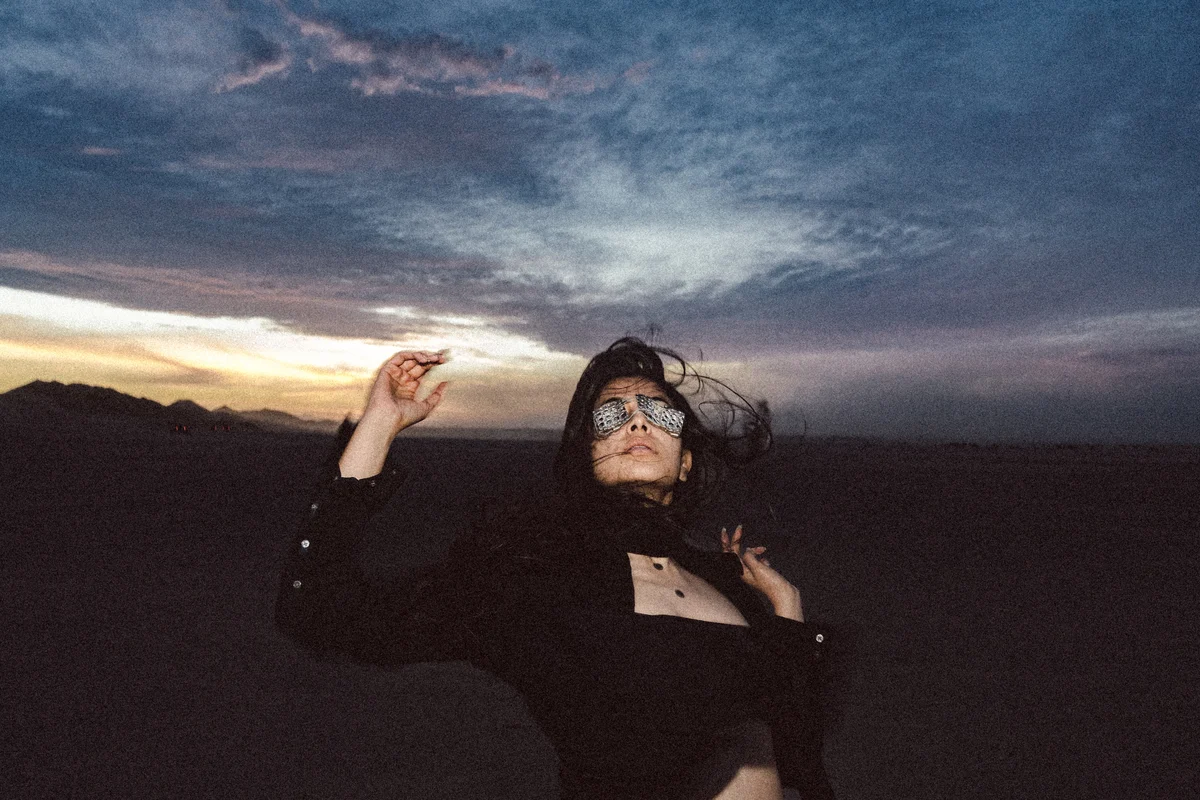

Sheherazaad’s colonial amnesia
Rejecting the South Asian ambassador label, the like-no-other Californian artist Sheherazaad tells Jasper Willems how forensically examining the fractures created by colonisation filigreed her relationship with language.
The human voice will inevitably change over time. I mean, it has to, right, given how we keep amassing new experiences and memories? Sheherazaad examines this notion even deeper; she describes the change of her own voice as a rehabilitation.
“I have never actually said this out loud before: I don’t really enjoy my own voice,” she says. “I like singing, but I don’t like hearing it back. The one thing that I am happy about, at least when it comes to my vocal performance after going through this whole rehabilitative kind of process of breaking the voice apart and putting it back together, is that there’s an ugliness. And I hope to find more ugliness.”
Sheherazaad thinks that, nowadays, with modern music production techniques, there’s both the temptation and the capability to make voices always sound pristine and conventionally pretty. “There’s all kinds of instruments, but the reason why I think people latch onto the voice so much is because it’s supposed to be an expression of our humanity. We are all deeply, deeply flawed beings. That’s why we’re here. So if the voice doesn’t reflect that with its own pitfalls, what is it even doing? How is it musical?”
Growing up in the San Francisco Bay Area with mixed Indian and Pakistani heritage, Sheherazaad was somewhat displaced from cultural and musical tradition: never quite at home with either Western or South Asian classicism. At the beginning of our conversation, she flippantly remarks that she’s still quite attracted to the nomadic lifestyle of a touring artist. Though she alludes that if she settles in places like San Francisco, New York, or London for too long, their influence might catch up to her again.
“Yeah, it’s wild, because my name is Sheher, which means city,” she answers, often letting my questions marinate with thoughtful pauses. “I historically have never liked cities. I think New York is really neurotic, increasingly so. I think everyone there is very borderline. London, I don’t have too much experience with. I’m very much a tourist when I go there, but it’s always a weird thing where, if I’m kind of enjoying myself too much there with my band or whatever, I feel like I have Stockholm Syndrome, because the UK colonised us in South Asia, where my parents are from at least. So it was always a weird relationship with the UK.”
She describes her South Asian-American household as free-thinking and encouraging: both her parents grew up in the ’70s as “total hippies.” Her grandmother, meanwhile, exposed her to a lot of legendary Indian music, producing concerts of its great figureheads around the West Coast during that time period. Sheherazaad’s own musical journey began studying jazz and the American Songbook from the tender age of six. Now that she’s developing a more autonomous intuitive voice, she tells me she wishes to be kind to her younger self: a kid who just loved to sing before things became a bit more complicated.
“I want to be nice to my younger self, a person who was basically just a parrot, parroting back English-sung music,” she reflects. “Because that’s all she knew at the time. She didn’t speak Hindi or Urdu, the languages that Khudgarzi is largely sung in. My younger self, she just wanted to sing, and she was just listening to CDs and whatever she could find of her parents’ music collection, which was like disco and, obviously, Bollywood. But, you know, I couldn’t do all of that Indian stuff. I was just an American kid.”
You won’t find verses, choruses, and sparkly arrangements on Khudgarzi, Sheherazaad’s impressive new LP, a set of intricate recordings that follows up 2024’s Arooj Aftab-produced mini-album Qasr. Though Sheherazaad works with over 30 befriended musicians and producers on Khudgarzi, it ultimately centers around her voice as it channels the Khudgarz Aurat, the Urdu term for ‘Selfish Woman’. The woman who will fearlessly chase selfhood and agency for herself, be it in a social or creative environment.

“There’s a lot of what I called like futuristic or dystopic folklore that I wrote into the lyricism,” Sheherazaad says. “And the lyricism was already very storied, and I wanted to have something like an invented cosmology or an invented ‘neo mythology’ that could form the basis.” This observation triggers the question whether Sheherazaad wants to lay down some kind of new groundwork or envision how her music will be interpreted decades down the line. “I’m sure most musicians would tell you this: we don’t really care what happens with the album now or in the future. For me, it almost feels like most of it, honestly, belongs in the past… and I wish this album was heard in the past.”
Sheherazaad says much of making Khudgarzi was a stab in the dark – her own singing as well as communicating the music with over 30 collaborators. Because these songs don’t adhere to any specific genre or tradition, everyone was encouraged to lean into their idiosyncrasies and instincts. The tally of featured artists includes Ria Modak (guitar), Sarathy Korwar (tabla, additional vocals), Jay Chakravorty (synths), Shunya (double bass, cello, violin, guitar), and Qasim Naqvi (additional string arrangement).
“I told many players to just keep the stakes really low, because I think musicians in general are operating in such a high-stakes world. Especially for people who have studied music. It’s really, really hard to not be a perfectionist about things and feel like it has to be a finished product. Or just a product.” Sheherazaad chuckles, as if replaying a specific session during the recording process in her head. “I’m from California, you know. I like to keep things very relaxed, and healing – because music should be healing.”
I ask Sheherazaad whether her own sense of displacement from these traditional styles actually allows her the fluidity to inhabit and interpret the characters she depicts on Khudgarzi. At the very least, it could be a noble thought to throw into the top hat. “There were a lot of girls that I grew up with, and boys as well, who were forced by their parents to make up for the fact that we had all moved to America,” Sheherazaad explains. “And so the parents would force their kids into these very, very traditional art forms, like Carnatic music, Hindustani music, Kathak, and Bharatnatyam. These are traditional dance forms, and the kids usually hated it and have nothing to do with any of that music to date, because of how traumatising it was to have it forced down their throats.”
Sheherazaad explains that her parents, being fairly progressive and open to Western (pop) culture and lifestyles, didn’t impose such things on her young mind. “And so, Indian culture, Hindu culture, these things were not forced down our throats. Which is why, naturally, we developed a curiosity towards these things later in life. I didn’t have a guru of classical Indian teachers breathing down my neck and telling me that I couldn’t then study jazz or opera. At the same time, I wasn’t super trying to be competitive with Western singing, whatever that looks like. I wasn’t trying to be on American Idol or something like that.”
In relation to these wholly different musical lineages, she describes herself as being “an ugly duckling”, an outlier who didn’t feel like she belonged anywhere in particular. “You find yourself in this in-between space that a lot of people talk about now – that’s very glamorous and fashionable now, but at the time it was pretty miserable and uncool. There was a lot of self-loathing and a lot of, like, feelings of being wrong and ugly and a total loser.”
It begs the question, however, where Sheherazaad’s own discomfort of listening to her singing voice comes from, especially given she grew up in a very culturally open-minded family environment. Sheherazaad explains it’s part of a larger regression of collective thought she’s sufficiently acquainted with.

“Firstly, there’s a cultural thing here: where I come from, being an artist is sort of looked down upon, unless you’re a really well-known money-making machine. And especially for women, historically, there’s that association. I don’t have to deal too much with this, but of course, it’s always there implicitly: when women choose to become artists, or sometimes when they’re forced to become artists, there’s a link between that and selling your body; sex work, prostituting yourself basically. So, for girls, historically in South Asia, there is that historic link, which I talk about in the record a little bit.”
She says that generally, there’s this cultural negative image about the titular selfish woman in South Asia. Women are seen as bountiful bundles of generosity: they give and they give, they serve and they serve, and they sacrifice. “And it’s beautiful. I had a lot of women in my family who were like that. I’m like that sometimes. It’s a really beautiful thing when anybody, regardless of gender, is sacrificial or generous. Especially in today’s day and age, when the world is so competitive and fast-moving, it’s a beautiful thing to see.”
Sheherazaad admits she does struggle with that sometimes, because Khudgarzi is certainly not “an argument to claim your selfishness and be in your villain era.” Though there is definitely a strong thread of that, she admits. “But I think it’s also a lamentation, a mourning over this fact: I would love to be more generous and more selfless. But what does that mean? To be a daughter, a sister, a mother, and also an artist? To be a woman living in 2026; someone who has to pay rent, someone who’s single, not married, doesn’t have children, and doesn’t have that extra societal validation or support? It’s just a really complicated thing, you know? And I hope that the album, if anything, just captures the beauty of the complexity of that.”
A significant step Sheherazaad made in coming into her own was the decision to stop singing completely for an extended period of time. Long stays in India expanded, and oftentimes scrambled, her frame of reference in a (largely positive) manner. Her mixed North and South Indian heritage shaped her young sense of identity and her accent. She turned to experimental theatre and Bollywood dance to express how her voice was changing. After moving to New York for university, she found a more radical South Asian arts community. She began following modern South Asian artists, exploring the UK’s history of Asian electronic counterculture, and eventually bumped into Arooj Aftab, who would later produce Qasr.
By focussing on writing mostly in Urdu and Hindi, she quickly began to realise where the English language falls short in transcribing certain expressions and feelings. “I don’t think English is beautiful at all,” she says. “Of course, people sing in English and have made it beautiful, but I didn’t want to do that; it didn’t feel beautiful to me when I sang in English. At the same time, I have a sort of racist relationship with Hindi, my supposed mother tongue. It was my parents’ language, the language they brought with them from India, but I didn’t grow up speaking or understanding it. I grew up listening to it in Bollywood music, and it sounded very beautiful to me.”
That relationship is a racist one, Sheherazaad argues, because it’s so romanticised, almost delusional. “Hindi can become exoticised even to me: I’ll latch onto one word and think it’s beautiful, when the word might be ‘dishwasher,’ you know? So what do you do? I don’t want to sing in English, but I have this very exoticised relationship with Hindi and Urdu, my parents’ languages. I have a fraught relationship with how I compose and what language I use, and I don’t feel right about it either way. ”
"Certain things are off limits and are too big for us mere peasant people, especially for women… especially for little girls."
It’s become a prevalent narrative from artists of a diasporic origin to return to their roots and find some level of personal enlightenment from that. Khudgarzi, however, appears uninterested in explicitly achieving such a thing. Sheherazaad seems more concerned with forensically examining the fractures created by colonisation and patriarchy than in intentionally trying to mend them. “There’s always this very romanticised longing to return to origin, to return to roots,” Sheherazaad replies. “The song ‘Kohinoor’ (Diamond) explores that: ‘What if our identity were given back? / What if colonisation hadn’t happened? / Who would we be? / Would we be strong? / Would we be wealthy? / Would we be beautiful in a way that we’re not now?”
Sheherazaad argues “Kohinoor” is certainly an attempt at some sort of reclamation. “But Hindi and Urdu also have their own histories. Despite the crushing legacy of colonisation and destruction that tried (and still tries) to admonish and eliminate these languages, there are other complexities. Hindi and Urdu both have their own histories of colonisation and supremacy. People have used these languages to stamp out others, so it’s a really complicated issue.”
As a child of immigrants in the diaspora, Sheherazaad says she never learned the full history of these persisting cross-cultural tensions. “I’m seen as a kind of cultural ambassador for South Asia, but I don’t really know my own history. The colonisers burned our textbooks, and we were left without a clear sense of our past. I also grew up in the West, so a lot of my album is about this colonial amnesia and hangover.”
In that line of thought, “Registaan” (Desert), featuring Daatri Dadhich, comes across as a spectral version of an India raga movement that’s stranded somewhere in the middle of the forest. But then the song gradually opens up as it progresses. “It is a very tongue-in-cheek satire of certain aspects of Indian classicalism,” Sheherazaad says. “Which I hesitated to say because I’m a student of it, and I have a guru of it, and I don’t want to be disrespectful.”
Sheherazaad does emphasise that it’s important to make these movements conversational to her own reality. “There is a certain amount of necessary disrespect and critique of any form of classicalism, because of its inaccessibility. And the verse in Rajasthan, ‘tereke dari kita dari kita dada,’ is called a tarana, and it’s an often-used technique in Hindustani classical music.” Albeit a sort of “bastardised” tongue-in-cheek kind of way. “And a very lazy way… I think that as a woman to do that, as a woman who’s not super studied up when it comes to Hindustani classical music, there’s a lot of gatekeeping. It should be a conversation.”

According to Sheherazaad, part of the reason why she has a “fucked up relationship with Indian classical music” is that it’s also a gendered relationship. “A lot of people who are considered the greats of Hindustani classical music, the legends, the ustads, the maestros… they’re all men. And for a woman to get to that level, it’s nearly impossible. I grew up as this amateur singer, trying to dip my toes, later on in life, into Indian classical music, having grown up with it a lot. My grandmother was bringing a lot of these artists over to our homes, to this region of California. So I grew up with all of it, but there was always this feeling that you can’t even touch it with a 100-foot pole. Because certain things are off limits and are too big for us mere peasant people, especially for women… especially for little girls.”
“Gulukara” is named after the songstress (often considered a derogatory term within these particular contexts); it’s a spine-chilling account of what Sheherazaad mentioned earlier, how women artists are often shaped to fit inside of the male gaze, like a form of prostitution. The song features vocals from rising Indian hip-hop artist Irfana, who Sheherazaad met way back in boarding school. She reveals that the original idea for Khudgarzi was to write a collaboration record together, but a personal tragedy befell Irfana, prompting Sheherazaad to finish it without her, releasing it under her own name.
Irfana’s contributions may have been reduced to “Gulukara” and “Qatil” (Murderess), but Sheherazaad says her influence looms in a much larger, perhaps more unspoken way across the entire album. “The moments that I spent with her in the album’s inception were really rich in solidarity, because both of us feel like these total outsiders everywhere. [Irfana] comes from this region in South India called Tamil Nadu, and she feels like an ugly duckling in her own way too. And so we did this long-distance relationship.”
In creating together, Sheherazaad and Irfana talked a lot about femme solidarity. “And what it felt like to be just like a dumb, pretty singer,” Sheherazaad says, “A person who doesn’t really have a lot of autonomy, who’s not really going anywhere. Who makes these little bedroom Instagram posts of them singing and wants to make it big, but probably won’t. And so we wrote “Gulukara”, and we dedicated it to all those girls – a lot of the girls who end up going into OnlyFans, becoming cam girls and [doing] sex work. There was this inextricable link throughout South Asian history, where women artists, legendary artists, brilliant artists, were also prostitutes.”
“They are part of the many ghosts that haunt Khudgarzi. But these women throughout history, even just for me and Irfana; what we’ve had to do in order to be considered legitimate composers or artists…” Sheherazaad pauses and rearranges her original thought, seemingly recognising the grim futility of getting into the specifics here. “There is this grey area, this shade of which no one wants to talk about, which is having an attractive aesthetic, and to some extent, selling your art by selling your body. This kind of ghost and this kind of sentiment is hugely, hugely entrenched into every song.”

Were some of the ghosts on the record inspired by more figures throughout history? To my question, Sheherazaad recounts all the songs on Khudgarzi for herself, giving herself a moment to remind herself. “There’s this woman named Qandeel Baloch who I actually found out about after we finished the production of “Gulukara”. But she’s a great example. She was one of Pakistan’s first female influencers, murdered by her own brother because of her online presence and the shame that it brought to their family by her being a public-facing aesthetic who showed a little skin and who brought a sultry kind of image to her online presence.”
“Mard” (Man) depicts a room of women who are all aware of the presence of a voyeuristic male figure, and under his intrusive gaze, they create their own survival language. It’s an extremely powerful but sometimes unsettling piece of music, even more so by the fact that the titular Mard is expressed through a sample vocal stem from early 1900, as Sheherazaad reveals. It captures more than a century of this same unsettling cycle.
Khudgarzi might sound like everything is played in the same space, but in reality the music is far more fragmented than it seems by ear. Sheherazaad took a monolithic hip-hop approach to many songs. “We were really aggressive and violent when it came to sourcing from anywhere by any means,” she laughs. With her collaborators she ripped stuff from random videos online, like bird noises and weather noise and the sounds of temple bells. “I found an old Bollywood sample pack that was really, really bad, and I went through hundreds of these sounds to try and find something that felt reminiscent of, like, old classic Indian Bollywood. And I think out of maybe, like, 500 sounds, I found only two that made it into the album.”
I again think about Sheherazaad’s earlier observation, where she yearningly said she wished Khudgarzi would have been something that was heard in the past. But also her wish to seek out more ugliness, something other than the patriarchy’s damaging framing of femininity. She reveals that “Zeher” (Poison), with its withered industrial flirtations, actually started out as a piano-based song with more of a melodic point of emphasis. But after playing it live a couple of times, it was clear that the melodies became toxic to where the music wanted to go.
“We had to scrap all of it,” Sheherazaad recollects, “because it just wasn’t working. Then I remembered that there’s this person in South India. There’s this region called Kerala, which is this very, very beautiful South Indian state. And it’s kind of eccentric in the art that it puts out too. It’s a little weird compared to the rest of India, even the artists from there. There’s one particular producer called 6091 (Drumyuga) from there. I really admired and respected his music from afar, so I asked him to be a part of that song because it started to become clear that there was this techno aspect to ‘Zeher’.”
Sheherazaad giggles, semi-embarrassed, admitting she never really liked or listened to techno music up until now. “Something was becoming apparent: it was there, lurking. The only person I knew of who does techno in a more folk style was him, so I basically brought him in, and he was able to develop the sound. He took these South Indian drums and treated them in a way that makes them sound more industrial. The voicing also became really manipulated. I still haven’t really processed that song. I can’t believe there’s a low-key techno track on the album.”
Both “Haqeeaqat” and “Haqeeqat II” were late additions, but far from insignificant ones. The latter recording is an inversion of the original: a duet where she sings benevolently to the past self she had just left behind, as a person with new agency. “This whole album, believe it or not, is a breakup album,” Sheherazaad laughs. “More precisely, a divorce album. I think this one song is about a woman who shows up at her ex’s place to get her stuff back. Her stuff is none other than her body parts: her limbs, her eyelashes, her legs. All these things of hers that were scattered around his place and that she needed back. Why? Because she needs to make her train. She needs to make her train back to reality: haqeeqat.”
There’s already an implicit thread in the lyricism about returning to some kind of origin. “That’s why taking the track and reversing it unto itself,” Sheherazaad says, “which is eventually what happened, made a lot of sense thematically. Metaphysically, we’re all caught up in the online digital world. I know many people feel this way: the moment we step away from our technology, it almost feels like some kind of return to reality. I just want to have a lot of faith in reality.” Sheherazaad thinks the speaker of this song, Haqeeqat, wants to have a lot of faith in reality too. When people are coming out of a relationship, the dream and fantasy of what that relationship could have been also come to an end. To return to reality is a big one.”
So is the reality still that Sheherazaad hates the sound of her own voice? Or has that reality shifted in some significant way making Khudgarzi? Maybe her voice is just radically shaped by past realities that keep awakening that discomfort with her own singing voice. It’s almost like breaking in a new pair of shoes. “Possibly, yeah. I’m just realising, as you’re saying this, that I hear a very English-trained voice attempting to sing Hindi and Urdu, potentially even colonising those languages’ musical traditions. Even though I’m singing in what I wish had been my mother tongue, I feel like a coloniser myself because I’m coming from Western vocal technique. It’s a painful relationship in that way.”
Sheherazaad is ready to deepen this relationship further after two remarkable albums; to depart from it, and to rupture it a little. “As a vocalist, the body is an instrument. Even when music is bundled into a digital format, separate from the human body, we’re still feeling things vocally and wanting and needing to express them. So for the next venture, I see myself leaning heavily into vocal experimentation. When I sing, I try to sound pretty because I don’t like my voice; I find it ugly in a non-righteous, non-punk way. I think I still try, very subconsciously, to appease the male listening gaze. So I’d like to experiment radically with the fem voice, for a fem gaze, or a genderless gaze. That’s where I think I’m heading.”
Sign up to Best Fit's Substack for regular dispatches from the world of pop culture